Showing posts with label Unclassified. Show all posts

Monday, 18 February 2019

Big O notation

The Big O notation is a commonly used notation to give a average time complexity. For exemple if I say walk 1km/hour for 10 hours then the time complexity is O(10) so O(N). N the number of hours. Usually in C++ you can do up to 10^7 operations. So if N=10^7, you must do O(N) or less. There is also two other notations a bit less popular : the Big Omega notation and the Big Theta notation. When you are working on a problem, it is important to analyse the time complexity and memory complexity. Oh yes, memory complexity ... You also use the Big O notation for memory complexity. It is also recommended to analyse memory complexity.

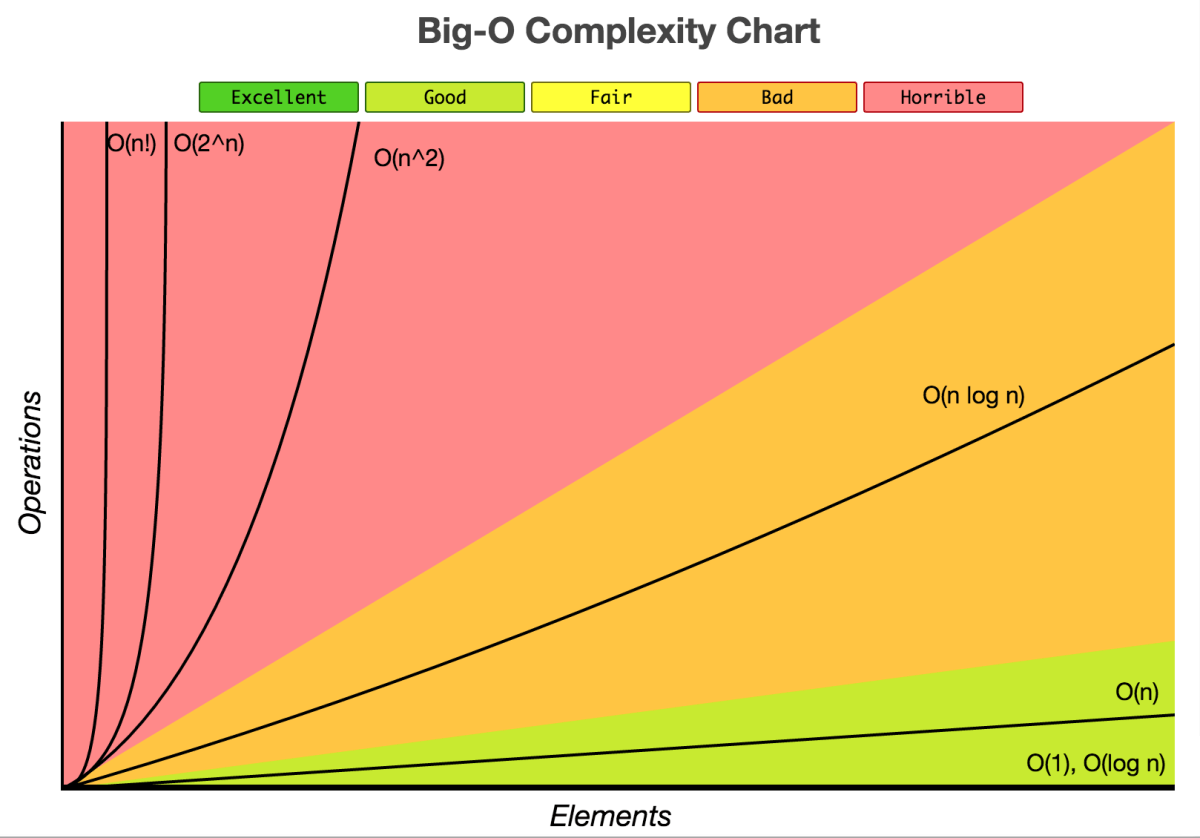
From Best Time Complexity to Worst Time Complexity, we have :
  • O(1) constant
  • O(log(n)) logarithm
  • O(sqrt(n)) square root of n
  • O(n) linear
  • O(n*n)
  • O(n^3) polynomial
  • O(n!) or O(n^n) exponential
A few exercises :

for (int i=0; i<n; ++i){
    // code
}
Time Complexity : O(n)

for (int i=0; i<n; ++i){
   for (int j=0; j<n; ++j){
       // code
   }
}
Time Complexity : O(n^2)

for (int i=0; i<n; i += 2){
    // code
}
Time Complexity : O(n) more precisely O(n/2)

int a=n;
while (a != 1){
    a /= 2;
}
Time Complexity : O(log(n))Image result for time complexity
Welcome on Algocorner !

This site will contain all the algorithms and notions that you will need for an interview or a competition. We will provide for each algorithm a C++11 code and a idea or a pseudo-code. We will also provide some articles on the syntax of C++ for beginners.

Algorithm : It's a sequence of operation. This sequence transforms an input into an output.

C++ : It's a programming language whose library contains all sorts of containers (ex. set, map). This library is often called the STL (Standard Template Library). This programming language is one of the fastest. Here, we use C++11, it's the C++ 2011 version.

std::next_permutation(arr.begin(),arr.end());

What is next_permutation(a.begin(),a.end()) ? Next permutation is like what its name says, finds the next permutation of a and assigns ...